English
 русский
 Deutsch
Industry News

+86-576-85198260
Welcome to Linhai Jingda Arts & Crafts Co., Ltd.





Welcome to Linhai Jingda Arts & Crafts Co., Ltd.
Mar 27, 2026
Comfortable seating spaces now play a key role in modern garden design. A relaxing corner that includes Garden Porch Swings often becomes the focal point of patios, decks, or shaded pergola areas. Some homeowners also place swings beneath a Backyard Swing Pergola to create a cozy and inviting place to unwind.
During installation planning, a common question appears in DIY forums and homeowner discussions: do porch swings require special hardware, or can standard screws and hooks handle the load?
Understanding the role of proper hardware is essential because swings create movement, and movement places repeated stress on mounting points and supporting structures.
Standard Screws Are Usually Not Enough
Basic screws or lightweight hooks are rarely suitable for hanging a swing. Porch swings generate dynamic forces while moving back and forth, which can loosen ordinary fasteners over time.
Structural guidelines recommend mounting swings only to load-bearing beams or ceiling joists capable of supporting both the swing and the people using it.
Installing hardware directly into decorative panels or thin ceiling boards may cause instability or failure.
Because of this, outdoor swing installations typically require heavy-duty components specifically designed for hanging furniture.
Common Hardware Used for Porch Swings
Several types of hardware are commonly used to support swings safely. Each component helps distribute weight and maintain stability during movement.
Swing Hangers
Swing hangers are specialized brackets that attach directly to structural beams. Some models include bearings that allow smoother motion and reduce stress on the mounting point.
Certain heavy-duty hanger systems are rated for loads of around 1500 pounds, providing a strong safety margin for porch swing installations.
Eye Bolts or Screw Eyes
Eye bolts with enclosed rings are frequently used when installing swings through wooden beams. Installation guides typically recommend bolts with at least ½-inch diameter and several inches of threaded length to provide sufficient strength.
Chains or Outdoor Ropes
The connection between the swing seat and mounting hardware is usually made using galvanized chains or weather-resistant rope. These components must also have appropriate load ratings.
Outdoor-rated chains and connectors help prevent corrosion and maintain stability over time. ()
Why Load Rating Matters
Weight capacity plays a major role in swing safety. A swing holding two adults may weigh several hundred pounds, and the motion of swinging increases the effective force applied to the mounting points.
Installation guidelines often recommend that support beams and hardware should handle several times the expected load, providing a safety margin for dynamic movement.
Because of these forces, choosing hardware specifically designed for swing installations is usually safer than using general-purpose fasteners.
Proper Mounting Location
Hardware quality alone does not guarantee safety. The location where the swing is mounted is equally important.
Recommended mounting points include:
Solid ceiling joists
Reinforced pergola beams
Structural crossbeams designed for load support
Attaching swings to thin rafters or decorative slats should be avoided because those components are not built to handle continuous motion loads.
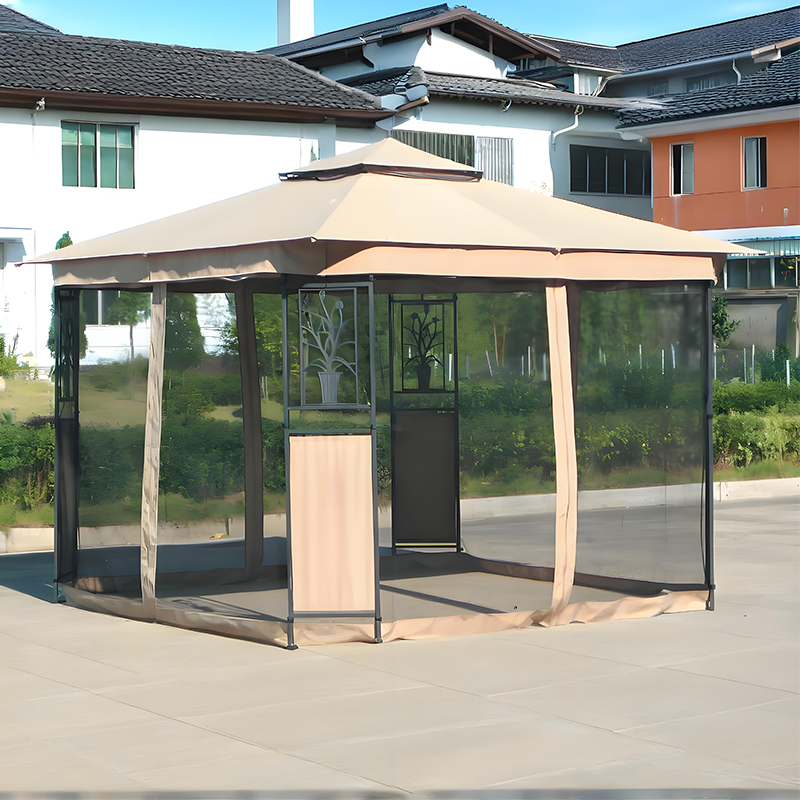
A Backyard Swing Pergola designed with reinforced beams and stable posts can provide a suitable mounting structure when properly anchored to the ground.
Clearance and Positioning
Correct positioning helps prevent hardware stress and ensures comfortable swinging motion.
Typical spacing recommendations include:
Around 3–4 feet of clearance in front and behind the swing
Hardware positioned slightly wider than the swing seat
Seat height approximately 17–19 inches above the ground for comfortable seating
These measurements help distribute weight evenly and allow the swing to move without hitting nearby structures.
Regular Inspection of Hardware
Outdoor swing hardware experiences constant exposure to weather conditions such as rain, humidity, and temperature changes.
Periodic inspection helps identify wear before it becomes a safety concern.
Maintenance checks may include:
Tightening bolts and connectors
Checking chains for rust or deformation
Inspecting wooden beams for cracks
Replacing worn connectors or hooks
Hardware is considered a wear component, meaning replacement may eventually be necessary after long-term outdoor use.
Creating a Stable Outdoor Swing Area
Relaxing garden spaces continue to influence backyard design trends. Seating elements such as Garden Porch Swings add comfort and movement, while structures like a Backyard Swing Pergola provide shade and visual appeal.
Proper installation hardware plays a key role in maintaining stability and safety. Durable swing hangers, load-rated bolts, and corrosion-resistant chains help ensure the swing remains securely mounted during daily use.
Outdoor furniture manufacturers including Linhai Jingda Arts & Crafts Co., Ltd. often design swing products with compatible mounting systems that simplify installation and support long-term outdoor use.
Thoughtful planning, appropriate hardware, and routine inspection allow a porch swing to remain both safe and enjoyable, turning an ordinary patio or garden into a comfortable outdoor retreat.
Your email address will not be published. Required fields are marked *
Copright © Linhai Jingda Arts & Crafts Co., Ltd. All Rights Reserved.

Custom Outdoor Leisure Patio Furniture Products